Rare Disease Recruitment Is Getting Harder. Is Türkiye Being Overlooked?
By Pelin Ozdemir | Senior CRA I, Cromos Pharma
Rare disease trials have a geography problem. The same limited patient populations are repeatedly pursued across established research markets, while potentially relevant populations elsewhere receive far less attention.
Türkiye deserves earlier consideration in rare disease country-selection strategies. Its distinctive disease epidemiology, national screening programs, expanding clinical research infrastructure, and increasingly systematic approach to rare disease tracking create a strong environment for clinical development. Rather than being considered only when recruitment becomes challenging, Türkiye has the potential to serve as a core country in rare disease development programs from the outset.
A Distinct Rare Disease Landscape
More than five million people in Türkiye are estimated to live with a rare disease. However, the opportunity is not simply about population size; it is also shaped by the country’s medical genetics expertise, diagnostic capabilities and specialist referral networks.
Türkiye’s population genetics, including relatively high rates of consanguinity in some regions, can contribute to a higher prevalence of certain autosomal recessive disorders than in many European populations.
Disease-specific data illustrate why this matters. Türkiye’s nationwide premarital spinal muscular atrophy (SMA) carrier screening program has been operating since 2021. A recent study of almost 20,000 people found an SMA carrier frequency of 2.26%, or approximately 1 in 44 people, with screening uptake reaching 87.9%.
Türkiye has also reported particularly high prevalence of other inherited conditions, including phenylketonuria (PKU), reinforcing an important point for sponsors: the relevance of Türkiye can vary significantly from one rare disease to another.
This evolving rare disease landscape is also supported at the national level. Türkiye’s 2023–2027 Rare Diseases Health Strategy and Action Plan aims to strengthen coordination across areas including diagnosis, treatment, data collection and access to care, supporting the development of a more structured rare disease ecosystem.
At the same time, the country faces a substantial gap in access to innovative treatments. There were 66 orphan medicines approved by the EMA between 2020 and 2023. By the end of 2024, only one had reimbursed access in Türkiye.
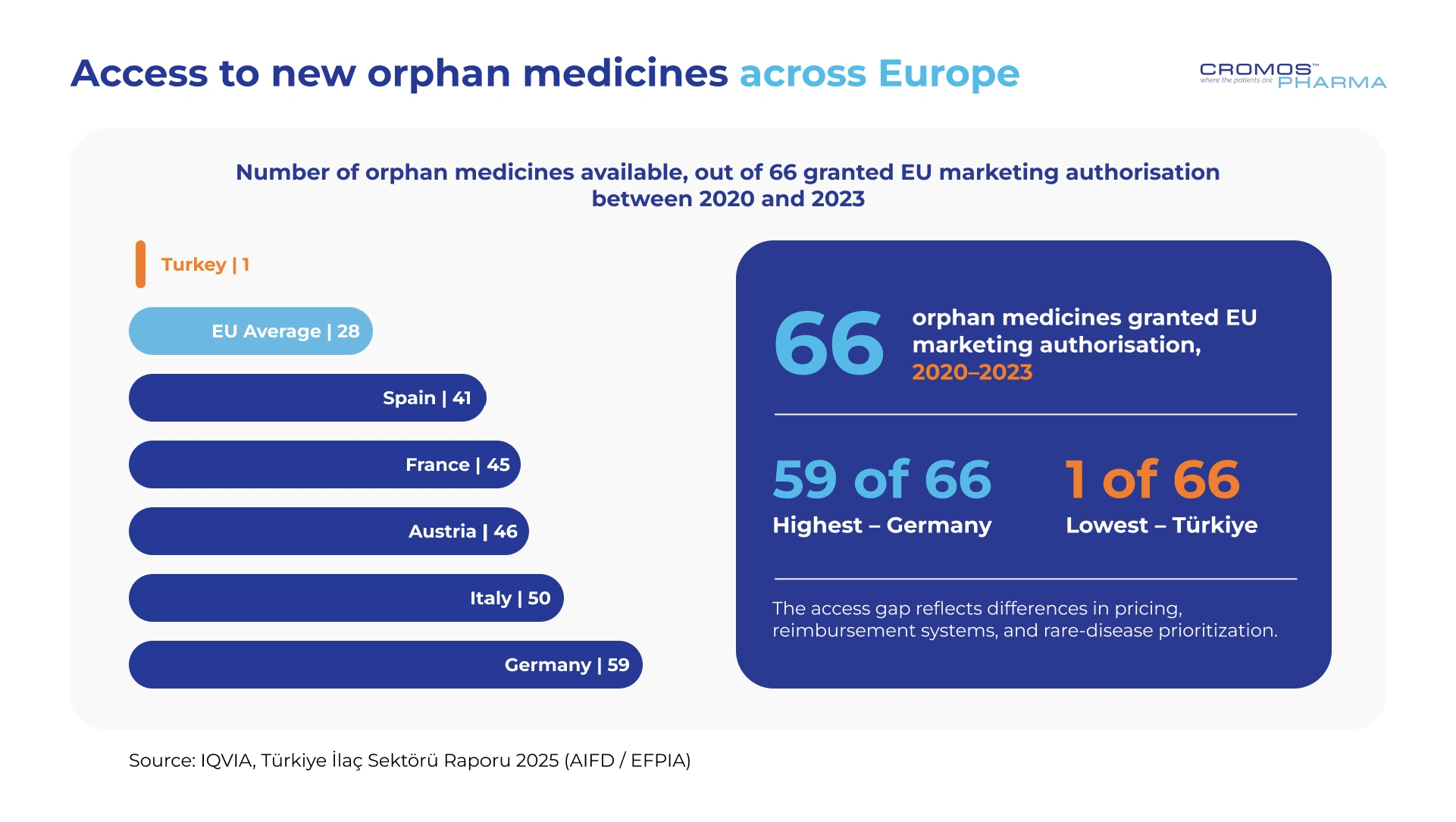
The access gap should not be interpreted as a recruitment advantage in itself. It does, however, underscore the degree of unmet therapeutic need within Türkiye’s rare-disease population.
Examples of Rare Diseases Relevant to Clinical Research in Türkiye
Türkiye’s rare disease landscape is highly heterogeneous, and reliable nationwide prevalence estimates are not available for every condition. However, published studies, national screening programs and disease registries demonstrate that a number of inherited and rare disorders have substantial or particularly identifiable patient populations in Türkiye. Higher rates of consanguinity in some regions are especially relevant to autosomal recessive diseases.
Examples of rare diseases | Epidemiologic evidence from Türkiye | Relevance for clinical development |
Phenylketonuria | National newborn-screening data and systematic reviews indicate an unusually high frequency; published estimates have reached approximately 1 in 6,000 births, among the highest reported internationally. | Nationwide newborn screening creates an identifiable diagnosed population and established metabolic-disease referral pathways. (PubMed) |
Spinal muscular atrophy | Premarital carrier screening has found a carrier frequency of approximately 2.26%, or 1 in 44, consistent with the figure already cited in this paper. | National carrier and newborn-screening programs provide unusually structured pathways for identification of affected families. (Frontiers) |
Beta-thalassemia | Average carrier prevalence is approximately 2.1%, with striking regional variation from 0.6% to 13%. | Established screening programs and specialized hematology centers make certain regions particularly relevant for feasibility. (PubMed Central (PMC)) |
Cystic fibrosis | Türkiye has a national cystic fibrosis registry; its initial report included 1,170 patients from 23 centers despite estimated registry coverage of only about 30%. | Newborn screening and established specialist centers facilitate patient identification and longitudinal follow-up. (PubMed) |
Duchenne and Becker muscular dystrophy | These disorders are prominent within Türkiye’s rare-disease clinical community; Duchenne/Becker muscular dystrophy represented the largest diagnostic group in a major Turkish rare-disease patient survey. | Concentrated neuromuscular expertise and specialized centers are relevant to gene, RNA and other advanced-therapy trials. (Frontiers) |
Mucopolysaccharidoses | Turkish referral cohorts demonstrate substantial numbers of patients across multiple MPS subtypes. A large diagnostic series confirmed 339 MPS patients, with several subtypes represented. | Specialized pediatric metabolic centers can concentrate otherwise highly fragmented ultra-rare populations. (PubMed Central (PMC)) |
Metachromatic leukodystrophy | A Turkish lysosomal-disease series estimated a minimum incidence of approximately 1.43 per 100,000 live births. | Relevant to highly specialized metabolic, neurologic and advanced-therapy development programs. (PubMed) |
Krabbe disease | The same Turkish series estimated a minimum incidence of approximately 1.0 per 100,000 live births and found Krabbe disease to be one of the more frequently identified sphingolipidoses. | Illustrates Türkiye’s potential relevance for very rare autosomal recessive neurologic disorders. (PubMed) |
Sandhoff disease | Estimated minimum incidence approximately 0.95 per 100,000 live births in the Turkish referral dataset; Sandhoff represented about 21% of diagnosed sphingolipidoses in that series. | Population genetics and referral concentration can make selected ultra-rare indications more feasible than national prevalence alone suggests. (PubMed) |
Gaucher disease | Documented within Turkish lysosomal-disease cohorts; older national referral data estimated a minimum incidence around 0.23 per 100,000 live births, although such referral-based estimates likely undercount disease. | Established metabolic and hematologic expertise provides identifiable referral pathways. (PubMed) |
Fabry disease | Targeted Turkish screening studies have identified Fabry disease in approximately 0.17–0.3% of dialysis populations, substantially enriching the population compared with unselected screening. | Demonstrates the importance of phenotype-based screening and nephrology referral networks rather than relying only on general-population prevalence. (PubMed) |
Congenital adrenal hyperplasia | Nationwide screening began in 2022. In its first year, 1,096,069 newborns were screened and 91 classical 21-hydroxylase-deficiency cases were confirmed. Earlier Turkish studies also suggested relatively high incidence. | National screening creates a clearly defined route from diagnosis to specialist pediatric endocrine centers. (PubMed) |
Primary immunodeficiency disorders / inborn errors of immunity | Turkish registries and specialist-center studies have documented large patient cohorts; high consanguinity is particularly relevant because many severe forms are autosomal recessive. | Established pediatric immunology centers and family-based case finding can support trials in genetically defined populations. (PubMed) |
Inherited metabolic disorders | Turkish centers report substantial numbers of disorders including biotinidase deficiency, phenylketonuria, glycogen-storage diseases and mucopolysaccharidoses; national newborn screening identifies several of these conditions. | Screening plus concentrated pediatric metabolism expertise can substantially improve patient identification compared with conventional site-database searches. (journal.acibadem.edu.tr) |
Sickle cell disease | Disease burden is geographically concentrated, particularly in southern Türkiye; national rare-disease analyses identify it as a clinically important inherited hematologic disorder. | Geographic concentration and established hematology networks make regional rather than national feasibility particularly important. (aifd.org.tr) |
These examples illustrate why rare disease feasibility in Türkiye should be indication-specific. The opportunity is not that every rare disease is more prevalent in Türkiye. Rather, population genetics, regional clustering, national screening programs and specialist referral networks can create unusually concentrated and identifiable populations for selected disorders. For sponsors, understanding these patterns before country selection can reveal recruitment opportunities that would be missed by relying on population size or historical trial activity alone.
An Established Clinical Trial Market with Untapped Capacity
Türkiye is already an established clinical research market, but the numbers reveal an interesting imbalance.
According to the Türkiye Pharmaceutical Sector Report 2025, 172 industry-funded clinical trials were initiated in Türkiye in 2024, placing the country 20th globally. The same report also ranked Türkiye 20th for trials initiated in 2024 that remained active as of September 2025.
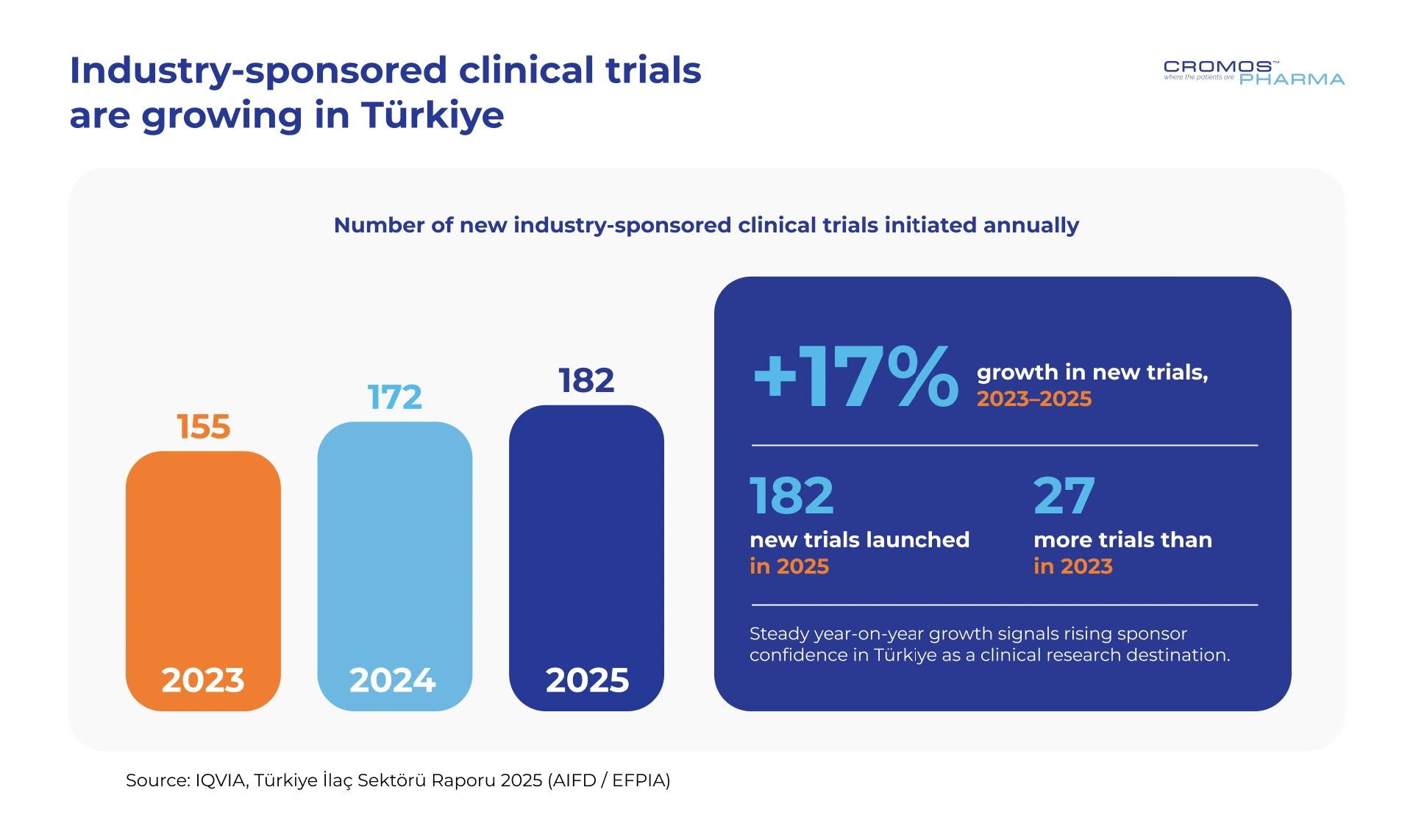 Yet when active trial activity is considered relative to population size, Türkiye ranks approximately 46th globally, indicating that activity remains below the level suggested by the size of its population
The contrast suggests meaningful untapped capacity. Türkiye has a large healthcare system and an established research infrastructure, yet clinical-trial activity remains relatively modest for its population size. For rare diseases, however, national averages are less important than indication-specific competition, referral pathways and investigator access to the target population.
Industry investment is already significant. Research-based pharmaceutical companies invested approximately $521 million in clinical trials in Türkiye in 2024.
The infrastructure supporting more complex development is expanding as well. As of August 2026, Türkiye had 24 TİTCK-authorized Phase I clinical research centers, located across major medical hubs including Istanbul, Ankara, Adana, Izmir, Kayseri, Konya, Gaziantep, Antalya and Samsun.
Regulatory timelines in Türkiye can be competitive, although review duration remains study-specific and depends on dossier completeness, ethics committee schedules and regulatory questions.
Together, these numbers point to a market that already has meaningful clinical research capacity but still has considerable room to grow.
Why Türkiye Matters for Rare Disease Sponsors
The important question is not simply how many rare disease patients live in Türkiye. For rare disease feasibility, national prevalence is only the starting point. Sponsors need to understand where patients with the specific genotype or phenotype required by a protocol are diagnosed, treated and referred.
This means looking beyond traditional country-level feasibility and examining:
- disease-specific and regional epidemiology;
- relevant genetic variants;
- diagnostic and screening pathways;
- specialist and referral centers;
- investigator access to patients;
- competing trials targeting the same population.
A disease may be rare nationally but concentrated within particular regions or referral networks. Similarly, a site with a relatively small existing database may outperform a larger center if it has strong referral pathways and access to newly diagnosed patients.
In Türkiye, this is particularly relevant because patients with complex and genetically defined rare diseases are often managed within specialized university and research hospitals. Identifying investigators who sit within established referral networks — rather than selecting sites based solely on historical recruitment figures — can therefore be critical to successful feasibility and recruitment.
In practice, selecting centers with verified access to the target population, active referral pathways and investigators closely connected to the relevant disease community can materially accelerate recruitment. Türkiye can translate this underlying potential into timely enrollment when site selection is driven by disease-specific patient pathways rather than institutional size alone.
Türkiye’s approach to rare disease data collection makes this particularly relevant. As part of efforts to better understand the country’s rare disease burden, data from key specialties, including pediatric neurology, pediatric metabolic diseases and medical genetics, are collected through the national health data system and reported to the Ministry of Health every three months. The data are intended to support a clearer understanding of disease burden and inform healthcare planning and policy.
For sponsors, this is an important development. More structured data collection, combined with screening programs and specialist referral networks, can gradually improve visibility into patient populations that are often difficult to identify through conventional feasibility alone.
Country-level data can tell sponsors whether Türkiye deserves attention. Disease-level intelligence determines whether Türkiye can actually recruit.
From Core Country to Rescue Country: Recruitment in Practice
Case Study 1 — When Türkiye Is Selected as a Core Country
Historical experience shows what can happen when the right indication is matched with the right center and investigator. In an international Phase III study evaluating pathogen-reduced red blood cells in patients with transfusion-dependent thalassemia (thalassemia major), 67 of the 80 patients in the intent-to-treat population were enrolled in Türkiye, compared with 13 in Italy.
Ege University Hospital in İzmir therefore contributed approximately 84% of the study’s evaluable population — a compelling example of Türkiye’s ability to deliver strong recruitment in specialized patient populations when the right centers are selected.
Case Study 2 — When Türkiye Delivers as a Rescue Country
In a Phase II study involving patients with cystic fibrosis and severe exocrine pancreatic insufficiency, Türkiye was introduced later in the recruitment strategy to support enrollment during the COVID-19 pandemic. Six Turkish sites were opened in October 2020, the first patients in Türkiye were dosed in November, and the study reached its targeted enrollment by March 2021.
The achievement came during a particularly challenging period for clinical research. The study required a substantial level of patient commitment, with participation lasting up to 81 days and efficacy assessments based on controlled dietary intake and three-day fat absorption measurements.
Despite these operational demands and the disruption caused by the pandemic, Türkiye enrolled 12 patients within approximately four months, with a Turkish site emerging as the study’s top recruiter. This performance provided substantial recruitment capacity during a critical phase of enrollment and contributed meaningfully to completion of the Phase II dataset.
The sponsor later specifically acknowledged the commitment of investigators and patients in Türkiye and Hungary despite the significant challenges posed by COVID-19. The case demonstrates Türkiye’s ability to deliver strong recruitment performance even when introduced later in a study and under particularly challenging operational conditions.
More importantly, it raises a broader strategic question for sponsors: if Türkiye can deliver this level of recruitment under these conditions after being introduced later in the recruitment strategy, what could it contribute when included as a core country from the outset?
From Potential to Recruitment Performance
Türkiye’s rare-disease potential is meaningful, but prevalence alone does not recruit patients. Success depends on identifying the right indication, understanding where eligible patients are diagnosed and treated, mapping referral networks and selecting investigators with genuine access to the target population.
For sponsors facing increasingly difficult rare-disease recruitment, Türkiye should therefore be evaluated early during feasibility and country selection rather than considered only after recruitment falls behind elsewhere.
The lesson from both the epidemiology and the case studies is straightforward: for the right rare disease, Türkiye can be a core recruitment country rather than simply a rescue option.
How Can Cromos Pharma Help?
Cromos Pharma combines an established local clinical operations team in Türkiye with international rare-disease development experience. We support sponsors with disease-specific feasibility, investigator and referral-network mapping, regulatory strategy, site activation and full clinical trial execution.
For sponsors evaluating Türkiye for a rare-disease program, the first question should not be simply whether patients exist. It should be where those patients are, who treats them, and whether the right sites can reach them.
To discuss a rare-disease feasibility assessment in Türkiye, contact inquiry@cromospharma.com