Clinical Trials in Italy: A 2026 Guide to Patient Recruitment, Regulatory Approval, and Study Start-Up
Italy offers pharmaceutical and biotechnology sponsors a compelling combination of specialized clinical expertise, established research hospitals, and access to patients across major therapeutic areas. Its oncology networks, university hospitals, and growing experience with innovative therapies make the country an important part of European clinical development strategies.
Recent regulatory changes, expanding early-phase research, and new initiatives to accelerate clinical trial authorization are creating additional opportunities. For sponsors evaluating Italy in 2026, understanding where the country performs particularly well, how its clinical research infrastructure operates, and what determines successful study execution is essential.
Why Italy? Research Infrastructure and Patient Access
One of Italy’s major strengths is its network of specialized hospitals that combine patient treatment with scientific research. The country has 54 officially recognized research institutions, known as Istituti di Ricovero e Cura a Carattere Scientifico (IRCCS), which are recognized by the Italian Ministry of Health.
These institutions specialize in areas such as oncology, neurology, cardiology, and rare diseases. Their combination of clinical care and research provides sponsors with access to experienced investigators, specialized patient populations, advanced diagnostic facilities, and established research teams.
This infrastructure is particularly valuable for complex clinical trials requiring molecular testing, multidisciplinary expertise, or access to patients with narrowly defined medical conditions.
Patient Recruitment Opportunities
Italy has the oldest population in the European Union, with a median age of 49.1 years, compared with the EU average of 44.9 years. This demographic profile creates significant opportunities for clinical research into age-related conditions, particularly oncology, cardiovascular diseases, and neurodegenerative disorders.
Italy’s specialist hospitals and referral networks can help sponsors identify patients with complex conditions, particularly in oncology, hematology, and rare diseases. However, recruitment opportunities extend beyond these established therapeutic areas. A 2026 analysis of Italian clinical trial activity found that older adults and pediatric patients remain underrepresented in clinical research despite their significant healthcare needs.
For sponsors, this highlights opportunities to broaden trial participation through appropriate eligibility criteria, patient-centered study design, and collaboration with specialized research centers.
Effective feasibility assessments remain essential to identifying suitable sites, estimating eligible patient populations, and developing realistic enrollment strategies.
Italy’s Clinical Trial Market: Latest Trends and Developments
Italy continues to attract substantial international clinical research activity. According to a recent analysis of applications submitted to the Italian Medicines Agency (AIFA), Italy’s national regulatory authority for medicines and clinical trials, the country recorded 838 clinical trial applications in 2025, compared with 735 in 2024.
The recovery is particularly notable following the decline observed during the transition to the EU Clinical Trials Regulation and the Clinical Trials Information System (CTIS).
Clinical Trial Activity Over the Last Five Years
Year | Clinical trial applications |
2021 | 864 |
2022 | 749 |
2023 | 688 |
2024 | 735 |
2025 | 838 |
Beyond the overall recovery, several developments are reshaping the Italian research landscape.
- International and Industry-Sponsored Studies
Italy plays an important role in international clinical research. According to AIFA’s latest National Clinical Trials Report, 90.9% of trials authorized in 2024 were international. Commercial clinical trial applications increased from 558 in 2023 to 680 in 2025, demonstrating continued growth in industry-sponsored clinical research in Italy.
- Growing Early-Phase Research
Italy remains active in Phase II and III trials, which accounted for 32% and 39.5% of applications in 2025, respectively. Meanwhile, Phase I applications increased from 88 in 2016 to 134 in 2025, reflecting growing opportunities for sponsors conducting early-stage clinical development.
Clinical Trials in Italy: Market Snapshot and Therapeutic Trends
Italy currently has 2,288 ongoing clinical trials, reinforcing its position as an important clinical research market in Europe. Oncology leads with 696 ongoing trials, followed by neurology with 390 and cardiology with 324.
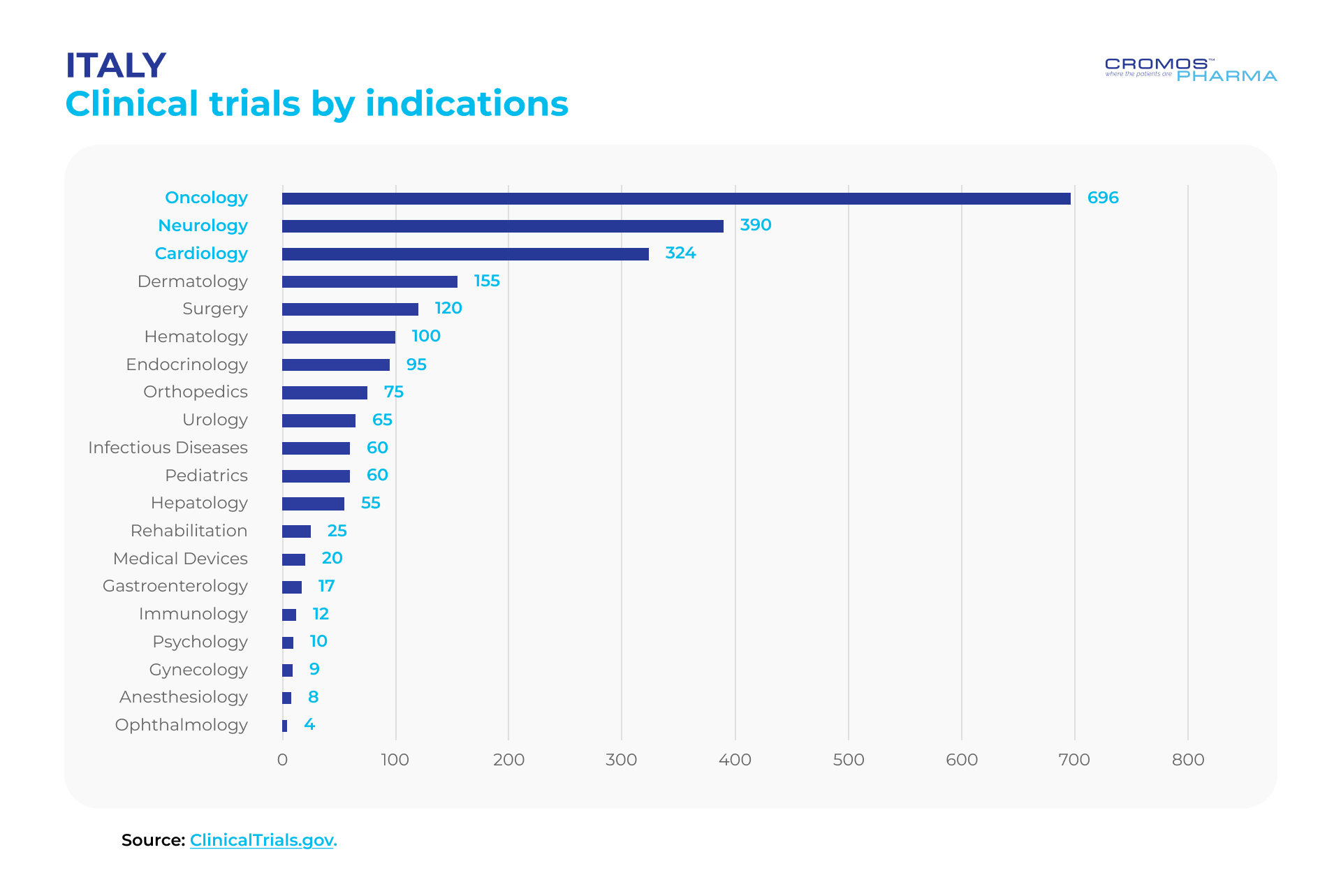
Italy offers established clinical research capabilities across oncology, hematology, immunology, and rare diseases, supported by specialized hospitals, experienced investigators, and advanced diagnostic facilities.
- Oncology and Hematology
Oncology is one of Italy’s leading clinical research areas. Specialized cancer centers, university hospitals, and research institutions provide expertise in targeted therapies, immunotherapies, and biomarker-driven studies, making the country an attractive location for complex oncology and hematology trials.
- Biologics and Antibody-Drug Conjugates
Biological therapies are gaining prominence in Italy’s clinical research landscape. Notably, antibody-drug conjugates (ADCs) have tripled in representation over the past decade, reflecting growing activity in innovative drug development. These studies benefit from specialized diagnostics and experienced multidisciplinary research teams.
- Rare Diseases and Advanced Therapies
Italy’s specialized research institutions offer opportunities for rare disease studies and advanced therapy medicinal products (ATMPs), including cell and gene therapies. Access to specialist investigators, diagnostic facilities, and patient referral networks is particularly valuable for these complex clinical programs.
- Immunology and Cardiovascular Research
Clinical research activity is also expanding beyond oncology. In 2025, Italy recorded 82 clinical trial applications involving immune system diseases and 67 in cardiovascular research, highlighting opportunities for sponsors across additional therapeutic area
Clinical Trial Approval in Italy: AIFA, CTIS, and Ethics Committees
Clinical trials of medicinal products in Italy are regulated under the EU Clinical Trials Regulation (EU) No. 536/2014.
The national competent authority is the AIFA. Since January 31, 2023, all new clinical trial applications under the regulation have been submitted through the Clinical Trials Information System (CTIS).
Applications consist of two components:
- Part I: Scientific and technical assessment, including the study protocol, investigational medicinal product information, and benefit-risk evaluation.
- Part II: National and ethical assessment, including informed consent, recruitment procedures, and country-specific documentation.
For multinational studies, Part I is assessed through a coordinated European process, while Part II is assessed at the national level.
Clinical Trial Authorization Timelines
The standard EU framework establishes the following basic regulatory timeframes:
Regulatory stage | Standard timeframe |
Validation | 10 days |
Assessment | 45 days |
Final decision | 5 days |
Basic authorization framework | Approximately 60 days |
These timelines may be extended by requests for additional information or applicable specialized assessment procedures.
Importantly, regulatory authorization does not automatically mean a site is ready to enroll patients.
Documentation and Language Requirements
Scientific and technical documents may generally be submitted in English, subject to national requirements.
Patient-facing materials, including informed consent forms and recruitment information, must be available in Italian.
Sponsors should also consider requirements relating to insurance, participant compensation, data protection, and institutional contracts.
2026 Regulatory Updates: Informed Consent and Clinical Trial Documentation
Italy introduced several updates to clinical trial documentation in 2026.
In March, the National Coordination Centre for Ethics Committees (CCNCE) published an updated standard contract template for clinical trials involving medicinal products.
In July, the CCNCE released revised informed consent guidance and standardized templates, covering adult participants, minors, and parents or legal guardians.
Further updates addressed personal data processing and participant reimbursement documentation.
For sponsors preparing new applications, these changes make it important to review the latest applicable national templates for Part II submissions and site contracting.
FAST-EU: Accelerating Clinical Trial Authorization
FAST-EU (Facilitating and Accelerating Strategic Clinical Trials in the EU) is a European pilot initiative introduced in 2026 to accelerate the authorization of eligible multinational clinical trials.
The initiative targets a maximum overall authorization timeline of 70 calendar days, including sponsors’ responses to regulatory questions, through coordinated assessments and closer cooperation between national authorities and ethics committees.
Italy is among the participating countries. Early pilot results have demonstrated the feasibility of this accelerated approach, although participation remains selective and acceptance is not guaranteed.
For sponsors, FAST-EU offers an opportunity to improve regulatory predictability and potentially shorten authorization timelines. However, site contracting, operational preparation, and patient recruitment remain separate processes.
Clinical Trial Start-Up in Italy: What Sponsors Need to Know
Regulatory approval does not mean a trial is ready to enroll patients. In Italy, site activation may require additional time for contract negotiations, budget approvals, pharmacy preparation, and staff training.
A 2026 study of two Italian oncology centers found that the median time from regulatory authorization to site activation decreased from 106 to 75 days following implementation of the EU Clinical Trials Regulation. However, the total time from submission to site activation remained approximately 168–169 days. These findings illustrate why sponsors need to plan beyond regulatory approval, although timelines vary by institution.
Regional Differences and Site Selection
Major clinical research centers are concentrated in regions such as Lombardy, Lazio, and Emilia-Romagna. These regions offer experienced investigators and specialized facilities but may also face greater competition for eligible patients.
For sponsors, effective site selection should consider:
- Patient recruitment potential: Eligible patients, referral networks, and competing trials.
- Site readiness: Contracting timelines, budget approvals, and available research staff.
- Clinical capabilities: Investigator experience, diagnostic facilities, and pharmacy infrastructure.
The key to faster study start-up is selecting sites based on both clinical expertise and operational readiness, with regulatory approval, site activation, and recruitment planned as connected activities.
Cromos Pharma: Clinical Trial Expertise in Italy
As an AIFA-certified CRO, Cromos Pharma supports pharmaceutical and biotechnology sponsors conducting clinical trials in Italy, combining local regulatory knowledge with international clinical trial management expertise.
Our services cover the full clinical trial lifecycle, from feasibility assessments and site selection to regulatory submissions, site activation, clinical monitoring, data management, biostatistics, and patient recruitment. Across our clinical trial portfolio, 95% of studies have met or shortened their planned enrollment timelines, demonstrating our commitment to efficient trial execution.
Planning a clinical trial in Italy? Contact our team at inquiry@cromospharma.com to discuss your development program and explore how we can support your study.