State of Biopharma R&D 2026: 7 Numbers Every Sponsor Should Know
Biopharma enters the second half of 2026 with no shortage of innovation.
- New modalities are advancing.
- Emerging biotech is responsible for an increasing share of clinical development.
- Artificial intelligence is moving from experimentation into R&D workflows.
And dozens of novel medicines continue to reach patients every year.
Yet the economics and execution of drug development tell a more complicated story.
- Development costs continue to rise.
- Timelines are lengthening again.
- Clinical programs are becoming more operationally complex.
- An increasing share of the industry’s future value is concentrated in a relatively small number of high-stakes assets.
For sponsors, seven numbers help explain where biopharma R&D stands today and where clinical development may need to change next.
$2.67 billion — the average cost of developing an asset from discovery to launch
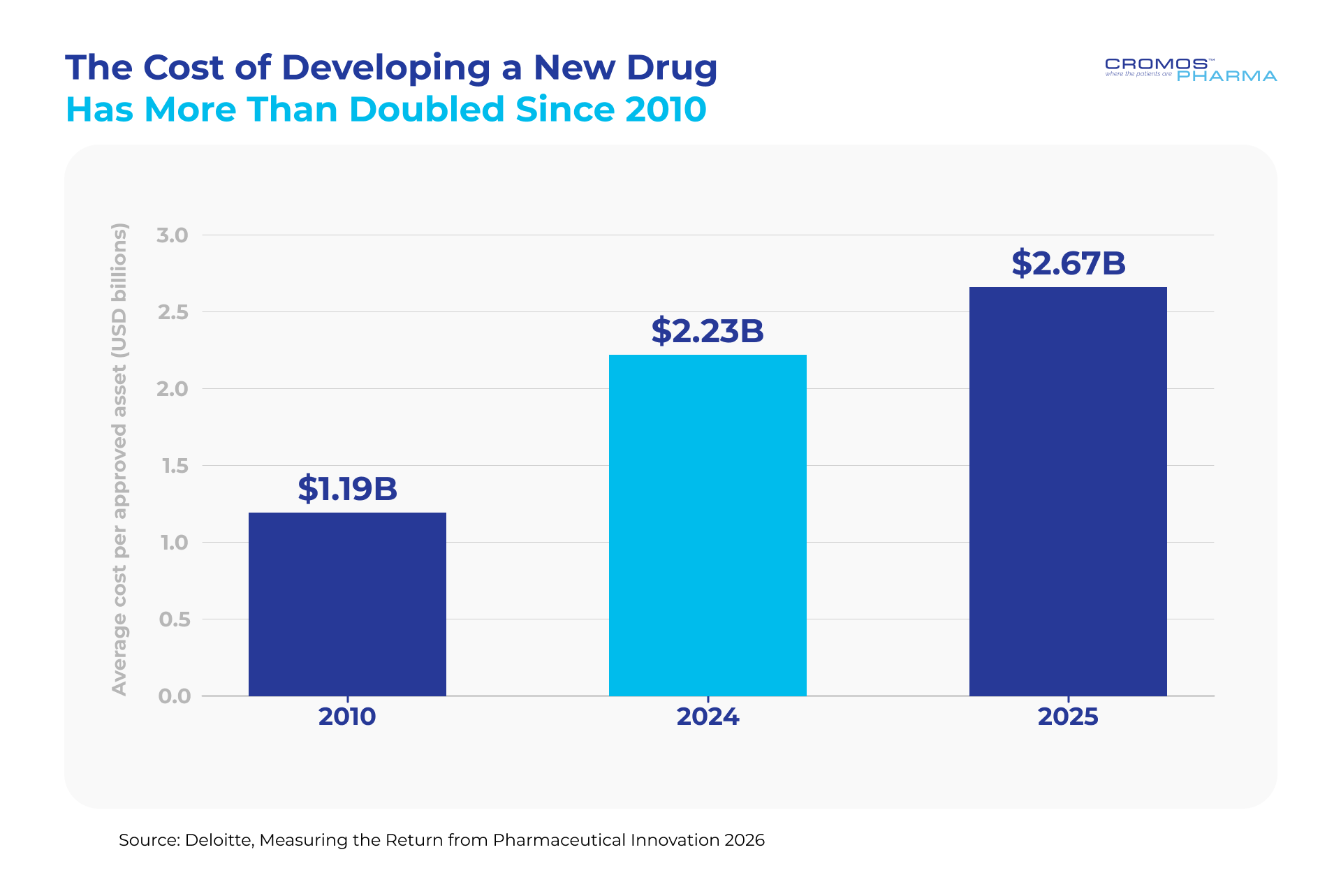
The average cost of progressing an asset from discovery to launch reached $2.67 billion in 2025, up from $2.23 billion the year before.
Over the longer term, the increase is even more striking: average development costs have risen from approximately $1.19 billion in 2010 to $2.67 billion today, more than doubling in 15 years.
The increase reflects far more than inflation. Clinical development itself is becoming more complex, with more sophisticated protocols, specialized endpoints, biomarker-driven patient populations, companion diagnostics and increasingly advanced therapeutic modalities.
What this means for sponsors
As development costs rise, operational inefficiencies become increasingly expensive. Poor site selection, avoidable protocol amendments, unrealistic enrollment forecasts, and delays between development stages can directly impact an asset’s economics, making speed, precision, and risk reduction critical to trial strategy.
68% — the share of clinical trial starts now driven by emerging biopharma
The center of gravity in clinical innovation continues to shift. Emerging biopharma companies accounted for 68% of global clinical trial starts in 2025, compared with 56% in 2019.
The shift is particularly visible in early development, where emerging companies now lead most Phase I activity. Large pharma remains more prominent in Phase III, where financial scale, global infrastructure and regulatory capabilities become increasingly important.
What this means for sponsors
For emerging biopharma, outsourcing is increasingly about more than adding capacity. As smaller companies drive a growing share of clinical development, access to experienced regulatory, country and operational expertise becomes increasingly important.
+3 months — the growing gap between clinical trials
Not every delay happens while a trial is running. Inter-trial intervals increased by three months in 2025, contributing to longer end-to-end clinical development timelines. Overall development timelines have now returned to levels comparable with the longest observed over the past decade. These gaps between studies can include study start-up, data management, report writing, decision-making and other activities required before the next trial can begin.
What this means for sponsors
Sponsors should increasingly manage clinical development as one continuous program rather than a sequence of independent trials. Completing one study faster creates limited value if months are then lost before the next begins, making early planning and coordination across regulatory, clinical, biometrics and operational teams critical to reducing overall development timelines.
117 — AI-enabled therapeutic assets have entered clinical trials
AI is beginning to move beyond drug discovery and into clinical development. A 2026 industry-wide analysis identified 117 AI-enabled therapeutic assets across 63 companies that had entered Phase I–III clinical trials. Oncology accounted for 59% of these assets, while 82% were small molecules. However, the pipeline remains heavily weighted toward early development: by the end of 2025, 60 assets had completed Phase I, while only eight had completed Phase II.
What this means for sponsors
AI-enabled drug development is becoming clinically tangible, but the real test is still ahead. For sponsors, the focus should shift from whether AI was used to discover an asset to whether it can improve the decisions that determine clinical success, including patient selection, trial design, feasibility and evidence generation.
One-third — the share of oncology trial starts involving novel modalities
Oncology clinical development is undergoing a fundamental shift. In 2025, one-third of oncology trial starts involved novel therapeutic modalities, including antibody-drug conjugates, radiopharmaceutical therapies, cell and gene therapies and multispecific antibodies. In 2016, that share was just 11%, representing a threefold increase in less than a decade. These therapies also bring greater operational complexity, requiring specialized sites and patient populations, stronger manufacturing coordination and more sophisticated trial design.
What this means for sponsors
As oncology trials become more specialized, site selection can no longer be driven primarily by patient numbers. Sponsors need to assess patient availability, investigator expertise, site readiness, diagnostic capabilities and operational requirements together, ensuring that sites can not only identify the right patients but successfully execute increasingly complex protocols.
9% → 70% — a small group of assets now carries most of the industry’s projected value
Just 54 blockbuster asset-indications, representing approximately 9% of the late-stage pipeline analyzed, are projected to generate around 70% of total risk-adjusted peak sales.
At the same time, obesity has overtaken oncology as the largest contributor to late-stage pipeline value for the first time in 16 years of analysis, accounting for approximately 25% of forecast sales in 2025, up from just 1% in 2022. This growing concentration means that the performance of a relatively small number of high-value programs can have an outsized impact on overall R&D returns.
What this means for sponsors
As more portfolio value becomes concentrated in fewer high-stakes programs, the cost of clinical delays and failure increases significantly. For sponsors, this puts greater pressure on early feasibility, protocol design, enrollment strategy and risk identification, particularly in late-stage development where preventable execution problems can put substantial future value at risk.
79 — novel active substances reached patients globally in a single year
Despite rising development costs and increasing clinical complexity, pharmaceutical innovation remains strong. 79 novel active substances were launched globally in 2025, bringing the five-year total to 388. Looking ahead, approximately 70–80 novel active substances are expected to launch each year over the next five years, supported by the current late-stage pipeline and historical success rates.
What this means for sponsors
A strong flow of new medicines also means a more competitive development environment. For sponsors, bringing an innovative asset to market increasingly depends not only on the science, but on moving clinical programs efficiently, reaching the right patients and generating robust evidence before the competitive landscape changes.
The bigger picture
Taken individually, these numbers describe different parts of pharmaceutical R&D. Together, they tell a much more important story.
- 68% of trials are being initiated by emerging biopharma.
- Novel modalities now represent one-third of oncology trial starts.
- And the industry continues to deliver close to 80 novel medicines per year.
Yet at the same time, development costs have reached $2.67 billion per asset, end-to-end timelines are lengthening, gaps between trials have increased, and 70% of projected pipeline value is concentrated in only 9% of advanced assets.
That is the paradox facing biopharma R&D in 2026:
The science is accelerating faster than the development model around it.
The next era of R&D productivity will not be defined by science alone. As pipelines become more complex, development costs rise and competition intensifies, the ability to turn scientific potential into clinical progress becomes a competitive advantage in its own right.
For sponsors, execution is no longer downstream from innovation, It is part of innovation.
If you are planning an obesity or metabolic clinical trial, contact our team at inquiry@cromospharma.com to discuss how we can support your development program.