CRO Clinical Trial Execution: What a CRO Does Across Phases, Costs, and Where Sponsors Go Wrong
What Is CRO in Clinical Trials?
A CRO (Contract Research Organization) in clinical trials is a company that helps sponsors plan, manage, and run clinical studies. CROs handle key activities such as site selection, patient recruitment, monitoring, and data management. In short, they are the operational backbone that allows sponsors to focus on strategy and innovation while ensuring trials meet FDA, EMA, and ICH-GCP requirements.
Developing a new therapy is a monumental effort. On average, it takes 10–15 years and over $1 billion to bring a drug from discovery to market. Along the way, sponsors must navigate strict regulations, ensure patient safety, and manage vast amounts of clinical data. Few organizations can sustain this scale in-house — which is why more than 80% of clinical trials worldwide involve a CRO.

What Does a CRO Do in Clinical Trials? (Phase by Phase)
A clinical trial CRO supports sponsors across all stages of a study, ensuring efficient execution and compliance.
Key responsibilities include:
- Study startup: protocol development support, feasibility assessments, site identification
- Site selection and management: identifying qualified investigators and activating sites
- Patient recruitment and retention: implementing strategies to enroll and engage participants
- Clinical monitoring: ensuring protocol adherence and data accuracy
- Data management and biostatistics: collecting, analyzing, and validating trial data
- Regulatory affairs: managing submissions and ensuring compliance with FDA, EMA, and ICH-GCP requirements
- Pharmacovigilance: monitoring patient safety and adverse events
By outsourcing to a CRO clinical trial partner, sponsors can accelerate timelines, reduce costs, and benefit from established site networks and advanced technology platforms such as CTMS, EDC, RTSM, and eCOA/ePRO systems.

Criteria also shift by therapeutic area — for oncology programs specifically, see our guide on how to choose the right oncology CRO partner for complex cancer trials.
Well-chosen CROs can cut timelines significantly. Industry data shows that trials managed by CROs are completed on average about 15% faster than those run solely by sponsors — a gain that directly accelerates patient access and drives earlier revenue.
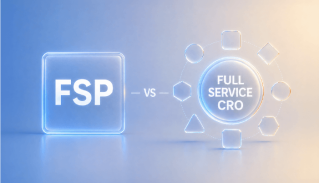
Full-Service CRO vs FSP Model
When choosing a clinical trial CRO, sponsors typically decide between:
- Full-Service CRO: one partner manages every aspect of the trial. This model offers speed and seamless integration but may be less flexible in specific functions.
- FSP (Functional Service Provider): the sponsor retains more control, outsourcing only certain functions (e.g., monitoring, data management). This approach adds flexibility and can optimize budgets.
- Hybrid models combine both, leveraging CRO expertise where it matters most while maintaining internal capabilities.
For a deeper dive into these models of collaboration, from Full-Service to FSP and Hybrid, explore our detailed article.
CRO Clinical Trial Cost Drivers
CRO pricing varies widely because clinical trials are not standardized products — each budget is shaped by the study’s design and scope. When sponsors evaluate a CRO clinical trial proposal, the following factors typically explain most of the cost variation between quotes:
- Trial phase: Early-phase studies (Phase I) usually involve smaller patient numbers but require specialized units, intensive safety monitoring, and PK/PD analysis, which raises the cost per patient. Later-phase studies (Phase III) lower the per-patient cost but increase total spend due to scale.
- Number of sites and countries: Multi-country trials add regulatory, logistics, and translation costs, but they also accelerate enrollment — often making the overall timeline (and therefore total cost) shorter. – **Therapeutic area and indication complexity:** Rare disease and oncology trials typically cost more per patient due to narrower eligibility criteria, longer screening, and specialized site requirements.
- Engagement model: A Full-Service CRO bundles all functions into a single fee structure, while an FSP model prices individual functions separately — this can reduce cost for sponsors with strong internal capabilities but adds coordination overhead. –
- Monitoring approach:Risk-based monitoring reduces on-site visit costs compared to 100% source data verification, without compromising data quality when implemented correctly.
- Data and technology stack: CTMS, EDC, RTSM, and eCOA/ePRO platforms can be priced as pass-through vendor costs or bundled into the CRO’s fee — always clarify which model applies before comparing bids.
A note on comparing CRO bids: the lowest headline number is not always the lowest total cost. Sponsors should ask for a full breakdown by cost category (labor, pass-through, investigator fees, contingency) rather than comparing single lump-sum totals — this is one of the most common reasons budgets go over plan mid-study (see the next section).
Where Sponsors Go Wrong When Selecting or Managing a CRO
Even experienced sponsors run into avoidable problems when outsourcing a clinical trial. The most common mistakes include:
- Underestimating feasibility
Choosing a CRO before a proper multi-country feasibility assessment often leads to unrealistic enrollment timelines discovered only after the study has started.
- Comparing bids on price alone
As noted above, a lower headline quote can hide gaps in scope, incomplete pass-through estimates, or thinner site networks — all of which surface later as change orders.
- Weak governance from day one
Without clear KPIs, escalation paths, and a defined communication cadence between sponsor and CRO, small issues (site activation delays, query resolution) compound into major timeline slips.
- Overlooking therapeutic area experience
A CRO with broad general capability but no track record in the specific indication may lack the site relationships and patient-recruitment insight needed for hard-to-enroll populations.
- Ignoring the CRO’s financial and operational transparency
Sponsors that don’t request real-time access to enrollment, spend, and milestone data often discover budget or timeline issues too late to course-correct.
- Treating the CRO relationship as “set and forget
The best outcomes come from sponsors that stay actively engaged — reviewing data and progress regularly — rather than fully delegating oversight after contract signature.
Avoiding these mistakes starts with the selection process itself — see the checklist below.
Key Factors for a Successful CRO Clinical Trial
Working with the right partner is critical. The most successful CRO clinical trials share these characteristics:
Area | Description |
Patient recruitment & retention | Proven strategies and digital tools to identify and engage participants. |
Robust data management | Secure, compliant systems that ensure data integrity and reliability. |
Regulatory expertise | Proactive management of submissions, RFIs, and compliance with EU CTR/CTIS timelines. |
Risk-based monitoring | Smart use of centralized data to improve quality while reducing site visit costs. |
Strong governance | Clear KPIs, communication cadence, and transparent reporting between sponsor and CRO. |
How to Choose the Right Clinical Trial CRO
Selecting a CRO is one of the most strategic decisions for a sponsor. Use this quick checklist to see if a CRO is the right fit for your clinical trial:

Selection criteria also shift by trial phase — see our guide on How to choose a CRO for Phase I and Phase II clinical trials for phase-specific considerations.
FAQ
What is a CRO in clinical trials?
A CRO is a company that supports sponsors in managing and executing clinical trials, handling operations such as recruitment, monitoring, and data management.
What does a CRO do?
A CRO manages key trial activities including site selection, patient recruitment, monitoring, data collection, and regulatory compliance.
Why do sponsors use CROs?
Sponsors use CROs to accelerate timelines, reduce costs, and access specialized expertise and global infrastructure.
What is the difference between a CRO and a sponsor?
The sponsor owns the study and is responsible for strategy and funding, while the CRO executes the operational aspects of the trial.
Partner with Cromos Pharma
At Cromos Pharma, we believe that every clinical trial is a step closer to transforming patient care. With over 21 years of experience as a full-service CRO, we bring together global reach, therapeutic expertise, and a proven track record of operational excellence.
Our team supports sponsors at every stage — from protocol design and regulatory submissions to patient recruitment, site management, and long-term follow-up. Backed by an ISO 9001:2015–certified quality system, we ensure compliance, efficiency, and speed without compromising data integrity or patient safety.
Partner with us to accelerate your clinical trial and deliver innovative therapies to patients who cannot afford to wait.